Architecting Dual-Mode Hybrid TLS 1.3 for ISO 8583 Payment Switches

- Lattice-based TLS handshakes push ClientHello and Certificate payloads beyond the 1,500-byte TCP MTU limit, triggering packet fragmentation.
- TCP fragmentation causes retransmissions and latency spikes that breach internal sub-10ms processing SLAs and cause switch timeout cascades.
- Dual-mode ingestion architecture utilizes persistent TCP connection pooling with 0-RTT session resumption to eliminate per-transaction handshake overhead.
- RFC 8879 certificate compression (zstd/brotli) compresses post-quantum certificate chains to keep payloads safely under MTU boundaries.
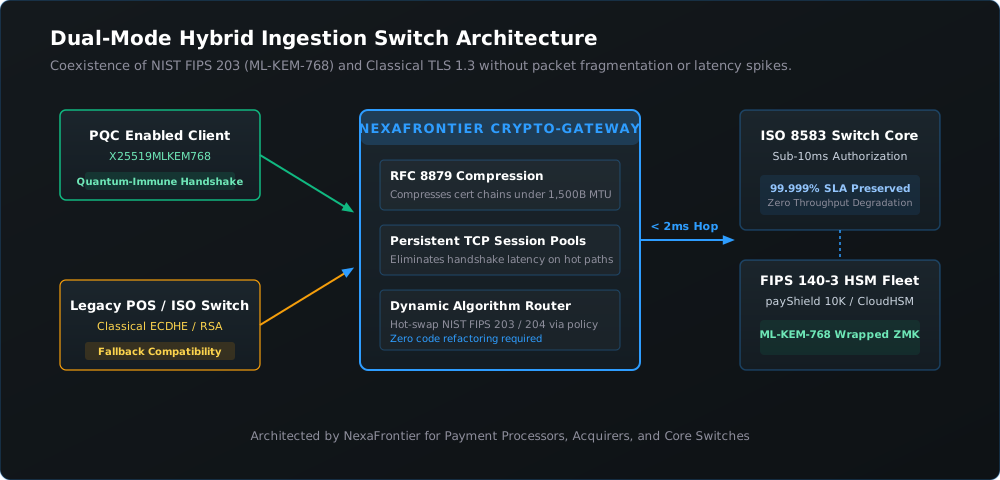
Strict Latency Budgets in Transaction Routing
Core transaction routing switches processing ISO 8583 and AS 2805 financial messaging operate under non-negotiable performance constraints. Acquirers, merchant aggregators, and card brand schemes enforce end-to-end authorization timeouts of 2,000ms, with individual internal hops restricted to sub-10ms processing windows.
Introducing post-quantum cryptography to transaction switches cannot be treated as a simple OpenSSL configuration flag. The increased message sizes inherent to lattice-based cryptography can easily push TLS ClientHello and Certificate payloads beyond the 1,500-byte TCP Maximum Transmission Unit (MTU), causing multi-packet fragmentation, TCP retransmissions, and latency spikes that trigger timeout cascades.
Zero-Downtime Dual-Mode Switch Architecture
To guarantee uninterrupted 99.999% uptime and preserve sub-10ms authorization speeds, NexaFrontier implements a Dual-Mode Hybrid Ingestion Architecture:
- TCP Connection Pooling with Session Resumption: Mitigate initial handshake latency by maintaining persistent, pre-negotiated hybrid TLS 1.3 tunnels with 0-RTT session resumption where compliant with PCI SSC session rules.
- Intelligent Payload Compression: Implement RFC 8879 TLS Certificate Compression (zstd/brotli) to compress post-quantum certificates and intermediate chains under MTU boundaries.
- Dynamic Algorithm Negotiation & Circuit Breaking: Route traffic through adaptive crypto-proxies capable of gracefully falling back to classical cipher suites if upstream processor endpoints do not yet support ML-KEM/ML-DSA.
Frequently Asked Questions
Larger post-quantum public keys and signatures exceed standard MTU boundaries, triggering multi-packet fragmentation and multi-millisecond handshake delays that cause sub-100ms ISO 8583 authorizers to breach SLAs.
By enabling RFC 8879 certificate compression (zstd/brotli), maintaining pre-negotiated persistent connection pools, and deploying dual-mode edge crypto-proxies.
It is the standardized hybrid key exchange combining fast classical ECDH with NIST FIPS 203 ML-KEM, ensuring continuous compliance and quantum resistance.

