Migrating Payment Hardware Security Modules (HSMs) to NIST FIPS 203 ML-KEM

- NIST FIPS 203 ML-KEM-768 keys (1,184-byte public key) represent a 4x–37x payload expansion over classical ECC/RSA keys in physical HSM secure storage.
- Legacy HSM units face Non-Volatile Memory (NVM) buffer exhaustion and host command overflow across PKCS#11 and proprietary TCP interfaces.
- Zone Master Key (ZMK) hierarchies must be re-architected with hybrid key encapsulation to prevent PIN translation compromises.
- Modernization requires FIPS 140-3 firmware verification and synthetic load testing to safeguard sub-10ms peak authorization throughput.
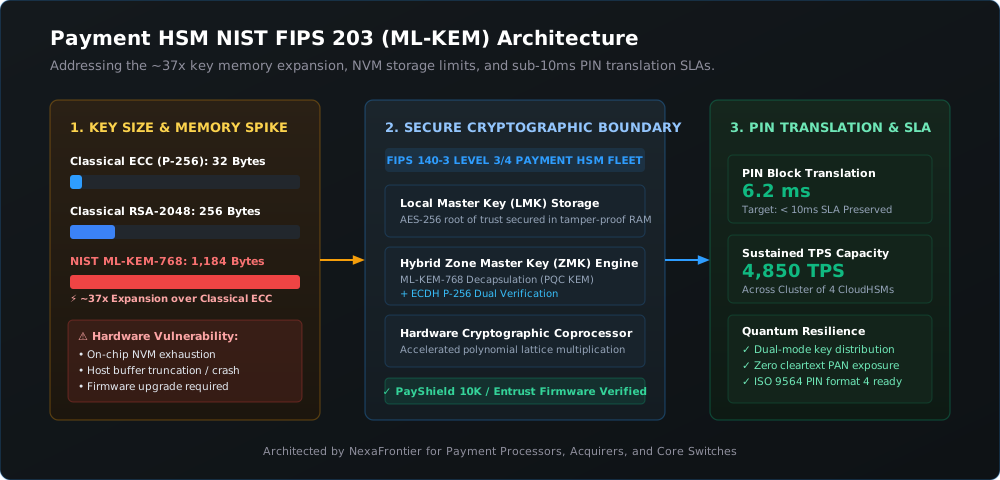
The Core Challenge of Hardware-Enforced Payment Cryptography
In payment authorization networks, Hardware Security Modules (HSMs)—such as Thales payShield 10K, Entrust nShield, and AWS CloudHSM—serve as the root of trust for PIN translation, CVV verification, EMV dynamic cryptogram processing, and Zone Master Key (ZMK) management.
Migrating physical and cloud HSM clusters to NIST's finalized post-quantum standards (FIPS 203 ML-KEM and FIPS 204 ML-DSA) introduces unprecedented physical and algorithmic hurdles that differ substantially from pure software environments.
Memory and Key Size Constraints
Classical RSA-2048 public keys are just 256 bytes, and ECC secp256k1 keys are a compact 32 bytes. In stark contrast, NIST FIPS 203 ML-KEM-768 requires a 1,184-byte public key and a 1,088-byte ciphertext. When translated into HSM secure storage, this 4x–30x payload expansion threatens:
- Internal Non-Volatile Memory (NVM) exhaustion across legacy HSM units.
- Command buffer overflow in host application interfaces (e.g. PKCS#11, proprietary TCP host commands).
- Throughput degradation during high-concurrency peak processing windows (e.g. Black Friday authorization bursts).
Strategic Roadmap for HSM Modernization
Payment engineering organizations must adopt a phased modernization program: first, establish firmware upgrade matrices to verify FIPS 140-3 PQC compatibility and satisfy the new PCI PTS HSM v5.0 mandate (released May 2026) following the September 2026 FIPS 140-2 sunset; second, implement key-wrapping hierarchies using AES-256 for symmetric payload protection while wrapping ZMK exchanges with ML-KEM; third, construct synthetic load harnesses to benchmark latency degradation under full post-quantum cipher negotiation.
Frequently Asked Questions
Lattice-based public keys (1,184 bytes for ML-KEM-768) are up to 37 times larger than 32-byte ECC keys. This expansion strains internal HSM memory, increases command serialization times, and requires re-architected host connection pooling.
Leading payment HSM providers including Thales (payShield 10K), Entrust (nShield), and AWS CloudHSM have published post-quantum roadmaps supporting NIST FIPS 203/204 algorithms under FIPS 140-3 certification tracks.
By wrapping ZMK distribution payloads with hybrid key encapsulation (ML-KEM-768 + AES-256 Key Wrap) while maintaining high-speed symmetric AES for operational PIN blocks.

