PCI DSS v4.0+ Cryptographic Bill of Materials (CBOM): Implementation Guide

- PCI DSS Requirement 4.2.1.1 and 12.3.3 strictly enforce documented cryptographic inventories across the entire Cardholder Data Environment (CDE).
- A production-grade CBOM maps Asset Location, Cipher Suite Primitives, Key Lifecycles, and Quantum Vulnerability Scores.
- Automating CBOM generation via passive network inspection and TLS endpoint scanning produces compliant OWASP CycloneDX 1.6 artifacts.
- A 14-day CBOM Discovery Audit gives CISOs and QSA auditors an auditable blueprint to pass compliance reviews with zero business disruption.
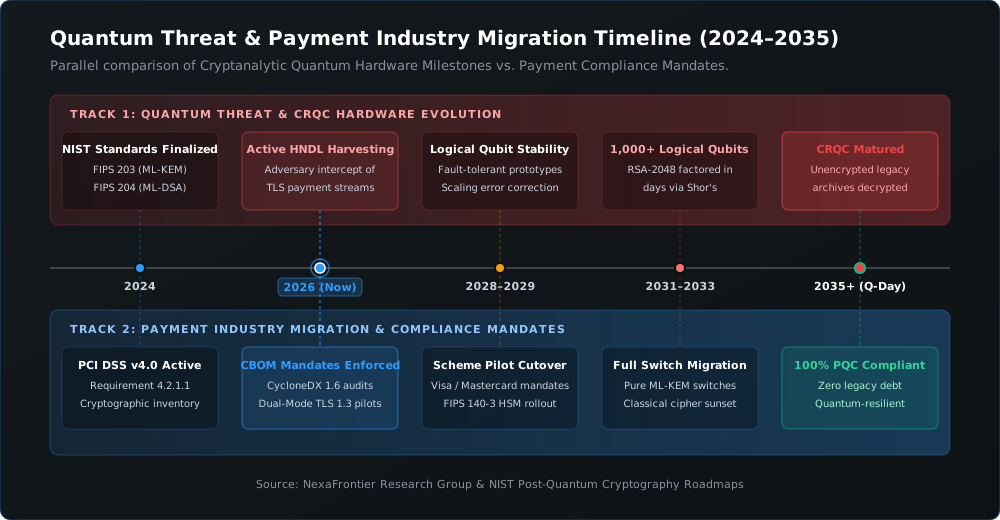
PCI DSS Requirement 4.2.1.1, Requirement 12.3.3 and the Era of Cryptographic Inventory
With the active enforcement of PCI DSS v4.0.1 (mandatory since March 31, 2025), payment entities can no longer treat cryptography as an unmonitored infrastructure layer. Requirement 4.2.1.1 and Requirement 12.3.3 explicitly require entities to maintain an up-to-date inventory of all cryptographic cipher suites, algorithms, keys, and certificates in use across the Cardholder Data Environment (CDE), with annual reviews and formal deprecation roadmaps. Relying on static spreadsheets is now a leading cause of QSA non-conformance findings during annual ROC assessments.
Furthermore, PCI Security Standards Council (PCI SSC) guidance and NIST guidelines strongly mandate that organizations establish a Cryptographic Bill of Materials (CBOM) to prepare for quantum cutovers.
What Goes into an Enterprise CBOM?
A production-ready CBOM must document four vital dimensions across every microservice, database, and network link:
- Asset Location & Owner: The service, container, ingress controller, or HSM partition utilizing cryptography.
- Cipher Suite & Primitive: Key encapsulation mechanism (e.g. RSA, ECDH, ML-KEM-768), signature algorithm (e.g. ECDSA, ML-DSA-65), symmetric encryption cipher (e.g. AES-256-GCM), and hashing function (e.g. SHA-256, SHA-3).
- Key Lifecycle & Expiry: Key length, rotation cadence, generation origin (software PRNG vs hardware TRNG), and certificate validity.
- Quantum Vulnerability Score: Categorization into Classical (Vulnerable to Shor's/Grover's), Hybrid (Quantum-Resistant), or Pure PQC (NIST FIPS 203/204 compliant).
Executing a 2-Week CBOM Discovery Audit
Rather than relying on outdated static spreadsheets, modern payment security teams utilize automated network-level passive sniffing, code repository static analysis, and TLS endpoint probes to generate living CBOM artifacts in standardized formats like CycloneDX 1.6.
Frequently Asked Questions
A CBOM is a structured, machine-readable inventory (such as OWASP CycloneDX 1.6) cataloging every algorithm, key length, certificate, protocol, and cipher suite active across an organization's systems.
Requirement 4.2.1.1 mandates that entities maintain an up-to-date inventory of all cryptographic suites used to protect cardholder data. A CBOM directly fulfills this audit artifact requirement.
With automated passive network inspection and endpoint scanning, NexaFrontier produces a comprehensive CBOM in a fixed 14-day discovery sprint.

